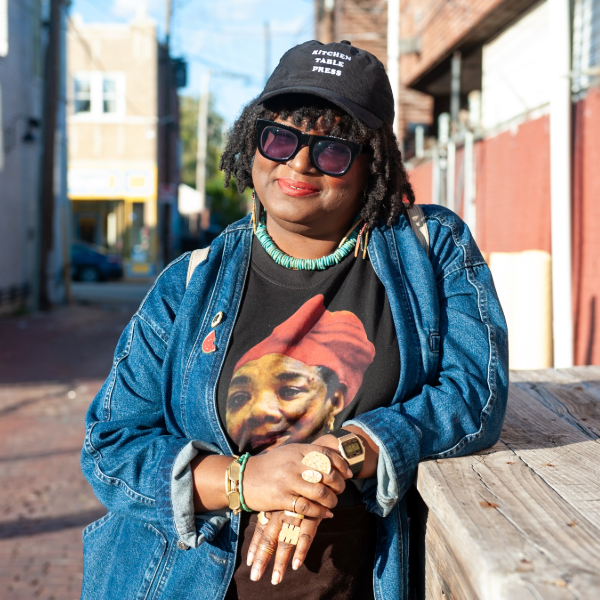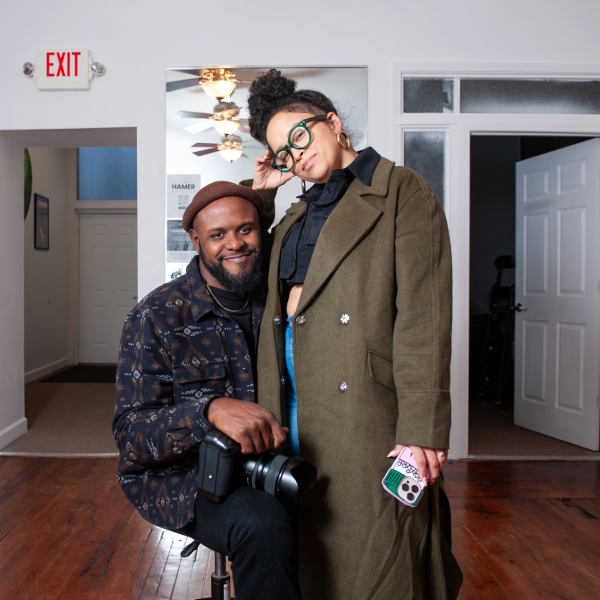
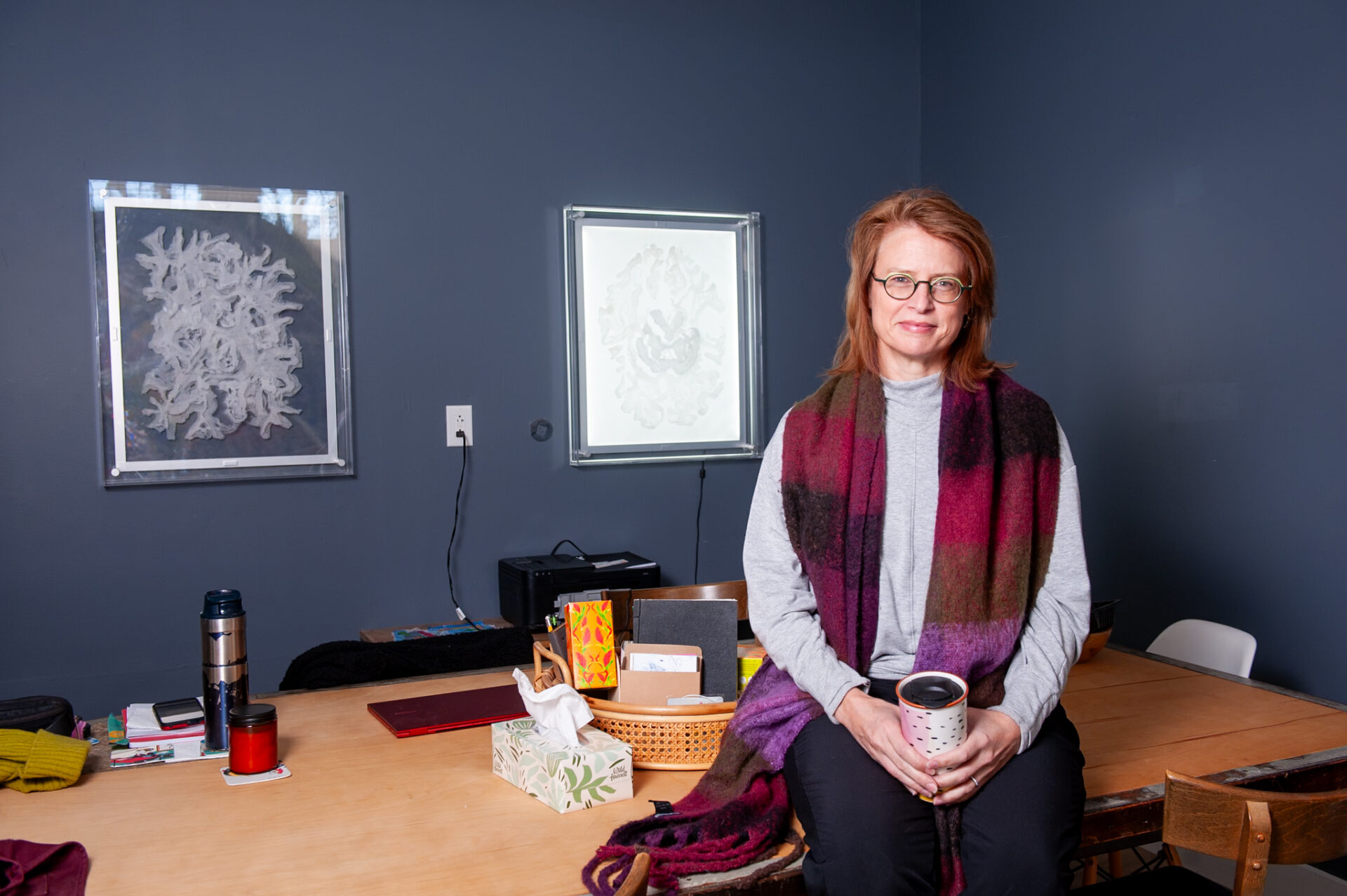
StLouisArts.org is powered by the Regional Arts Commission of St. Louis, and RAC is excited to partner with Humans of St. Louis to highlight stories from some of the talented creatives and artists who call St. Louis home. All stories and photography in the RAC + Humans of St. Louis series were created by and are credited to Lindy Drew, co-founder, lead storyteller, and book co-author of Humans of St. Louis.
Adrienne Outlaw
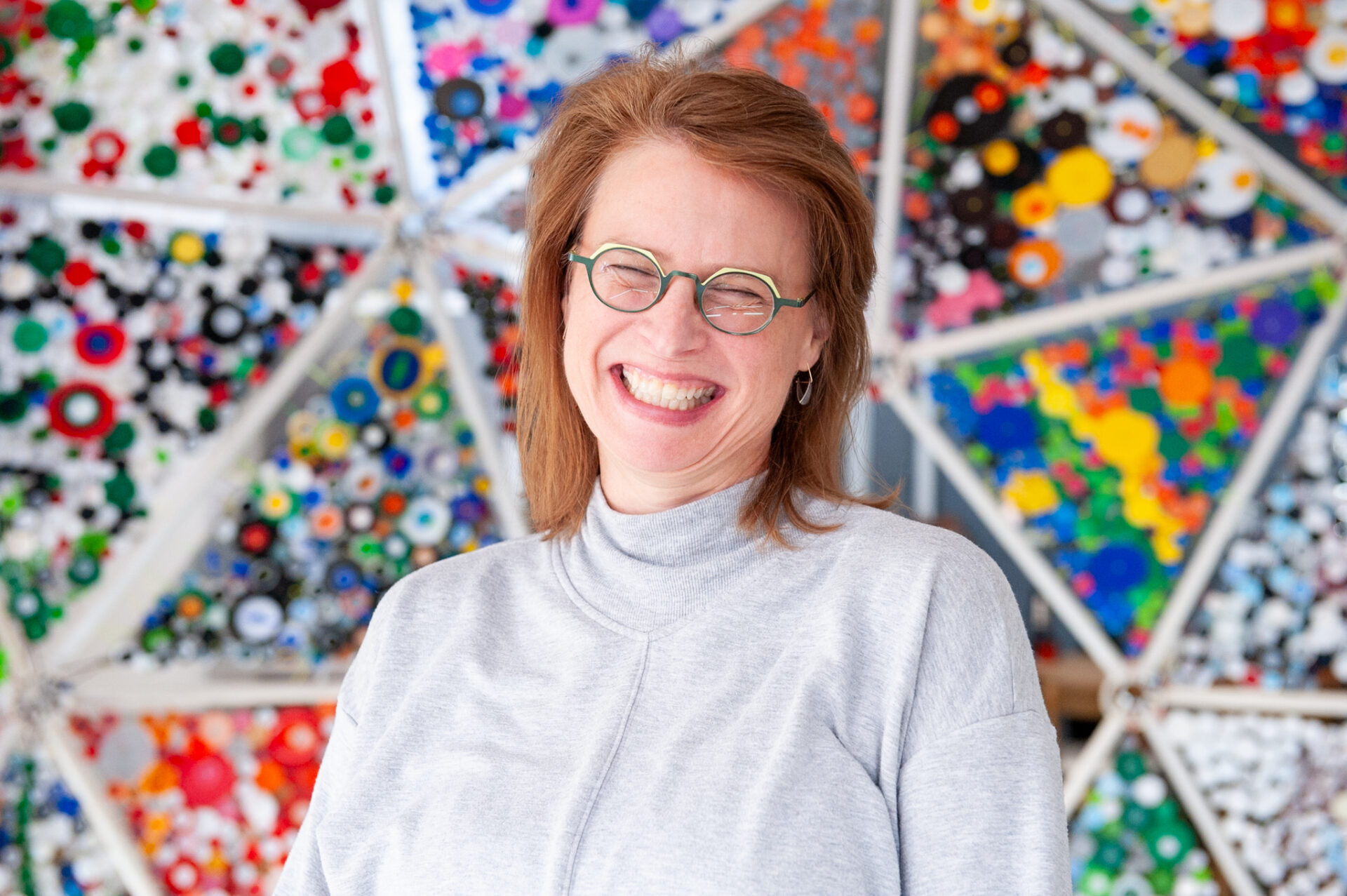 Photo credit: Lindy Drew / HOSTL
“My parents are obsessive about reusing and finding things. And because of them, I guess I found a beauty in discarded items. We’re all such avid thrift shoppers. You know, why buy something new when you don’t need it to begin with? My mom’s been known to send me a guitar without strings and say, ‘You could string it or take it back to Goodwill.’ And I’d always be like, ‘Stop doing that, Mom. You’re just overwhelming me with broken things.’ What’s wild now is that I kinda do that, too. I’m on FREEcycle, where people post, ‘I need this, and I don’t want to pay for it.’ Recently, this family visited St. Louis because their child was having serious medical issues. So the mom reached out needing some things, and I wrote, ‘You’re in luck, I’m in the process of getting rid of stuff. I’ve got three IKEA bags full of blankets and clothing your daughter’s size, as well as Christmas gifts for both of your kids.’ But I was feeling kind of guilty because I didn’t have time to go through the games and make sure all the pieces were there. So I had to turn around and do to her what my mom did to me. I did, however, reach out to the lady, saying, ‘I don’t want to overwhelm you with random bras and leggings and cute sweaters. Tell me if you want me to curate it a little bit.’ But she said, ‘No, just bring it over.’ What a funny full circle. Because you do become your parents.”
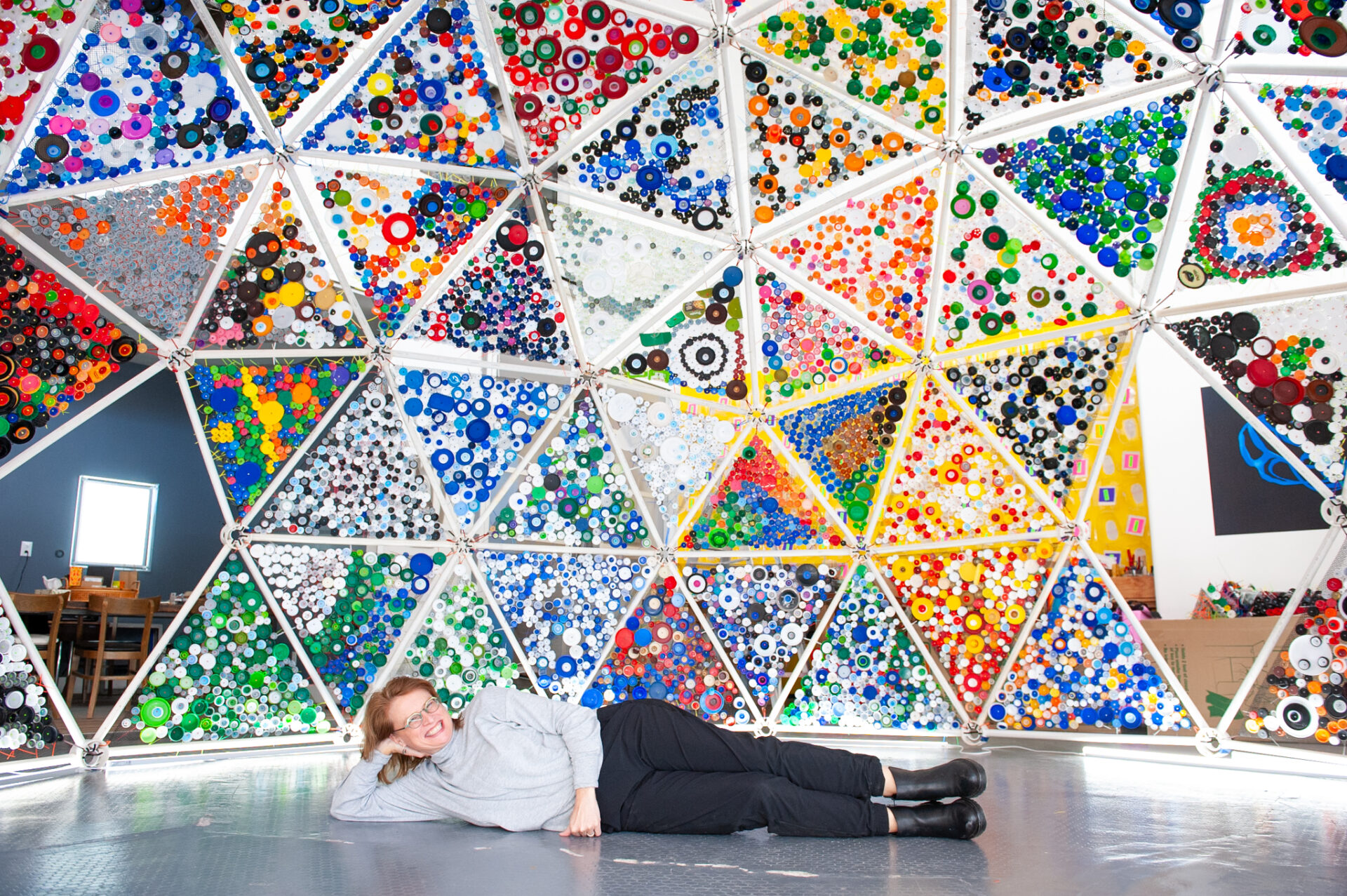 Photo credit: Lindy Drew / HOSTL
“My dad was a salesperson, so moving from state to state every couple of years, I was very nomadic as a kid. It’s only since my parents have had a house to themselves that they amass things. Every time my brothers or I visit, we help them curate. Still, there’s something beautiful in buying things at the thrift shop as opposed to them going into a landfill. I’ve become so frustrated with billionaires. And I’m proud of myself because I haven’t bought anything off of Amazon or Target since January 2025. Even that was an interesting process to go through, because for what I do, I’m often looking for a very obscure item I need to make my artwork. You can track down the manufacturer to buy some things directly. But I’ll still come to find out that a company just uses Amazon as the only way to distribute their goods. So almost every time I need or want something, I’ll start by going to Facebook Marketplace, Poshmark, or Goodwill. And 90% of the time, that item materializes. It’s been well-loved by somebody, and I get it from somebody in the city who I also get to have an awesome conversation with. In fact, that’s actually how I really started to learn about St. Louis.”
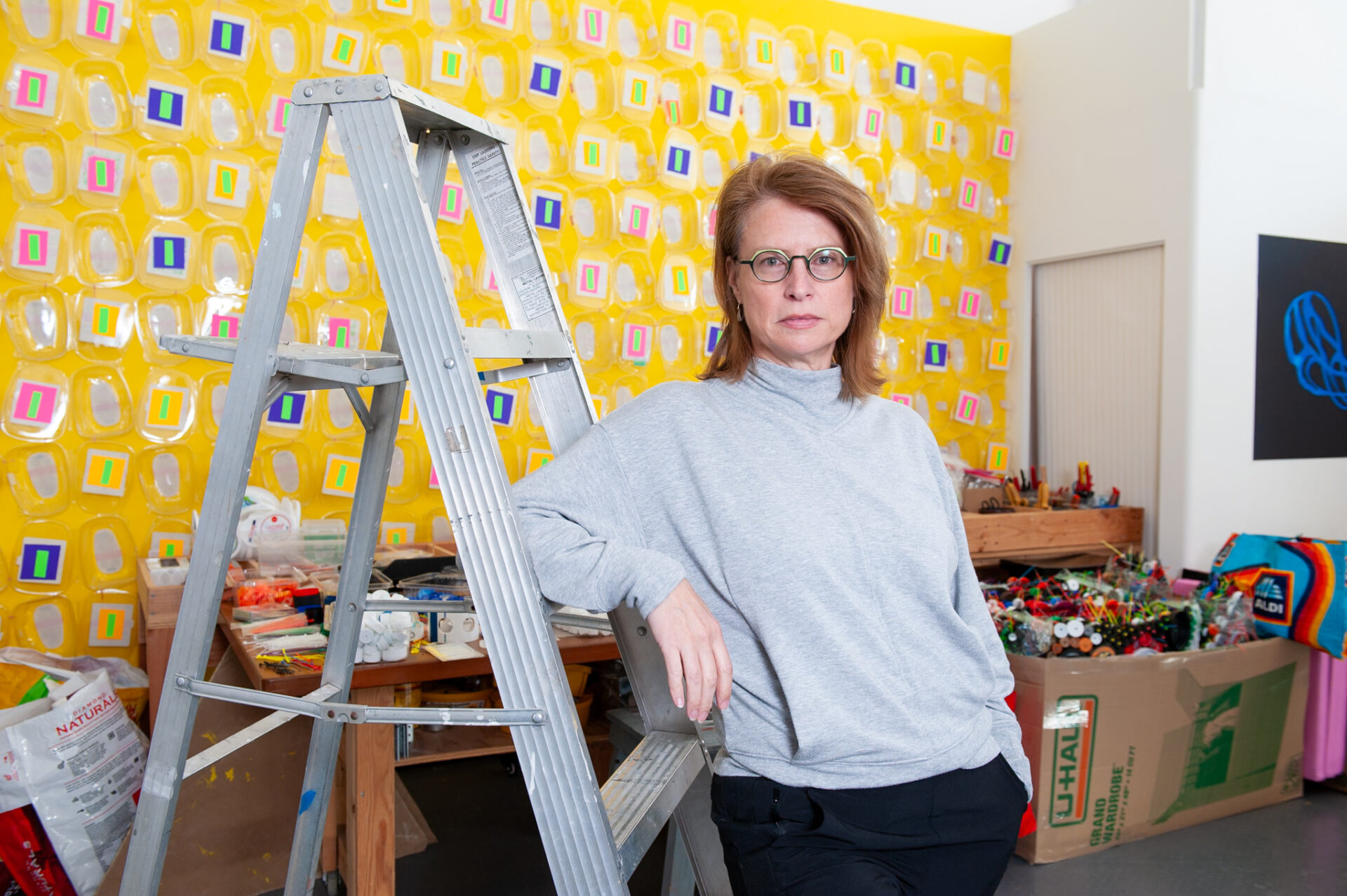 Photo credit: Lindy Drew / HOSTL
“When my husband and I moved here in 2015, I was already spent. I had started a nonprofit, but I never paid myself for running it. I had just completed my largest social practice exhibition supported by the National Endowment for the Arts and a solo show in Atlanta. I had children at home, and we were moving. When we got here, I used my maiden name to introduce myself so no one would know my background. I really wanted to just meet people. And we would like each other because we liked each other, or we would not like each other because we didn’t like each other. But it had nothing to do with a transactional relationship. In the end, as I tried to slowly build my community, I didn’t get to know that many people. Then COVID happened, and I found this whole community who, like me, were all stir crazy and doing things like building our own furniture, redecorating our own houses, and selling things or offering things up for free on Facebook Marketplace. I’d drive out to some random place and have these hour-long conversations with someone in their yard while picking up some random item, and it was awesome. One of the first things I noticed when moving to St. Louis was all the physical barricades to neighborhoods. You just can’t get in and out easily or go through a cut-through street. And I’m sure those things have their purpose, but it prevents people from getting to know these neighborhoods. So, going to pick up used furniture or whatever was a neat way for me to see a bunch of beautiful neighborhoods in and around this city, and even further.”
Photo credit: Lindy Drew / HOSTL
𝑊ℎ𝑒𝑛 𝑤𝑎𝑠 𝑡ℎ𝑒 𝑓𝑖𝑟𝑠𝑡 𝑡𝑖𝑚𝑒 𝑦𝑜𝑢 𝑒𝑥ℎ𝑖𝑏𝑖𝑡𝑒𝑑 𝑦𝑜𝑢𝑟 𝑤𝑜𝑟𝑘?
“That’s a fantastic question because I don’t know if I know the answer to that. I don’t know that I ever thought about exhibiting until sometime during college. I went to the School of the Art Institute of Chicago near the height of the AIDS epidemic. And I remember my school bringing us all into an auditorium without telling us what we were about to see or why. No context whatsoever. They showed us this film about safe sex — dental dams and the whole thing. My roommate came from a small town and was traumatized by the movie. Anyway, I decided to raise money for an organization helping people who had HIV or AIDS. I made one outfit entirely out of rubber gloves and another out of condoms and put condoms in the pockets. So I thought I was gonna go to school to become a fashion designer. I had models wearing the clothes, and this interviewer came by, looked at the outfits, looked at me, and he said, ‘You didn’t make that.’ I was like, ‘You’re just judging me by the exterior. You have no idea what’s inside.’ In high school, I had gone sort of hardcore and punk. So by the time I went to art school, I had gotten a lot of that out of my system. By then, I was dressing very Midwestern in sweatshirts and sweatpants. But one of my professors pulled me aside and said, ‘Don’t worry about what people say.’ I didn’t know anybody was saying anything. And he encouraged me, like, ‘Your work is good.’ That was the beginning of being told — many times in my career, mostly by male reporters — that I’ve succeeded because I’m attractive or whatever. And I’d be like, ‘Well, maybe it’s because I’m working really hard.’ Boy, there were so many frustrating interactions.”
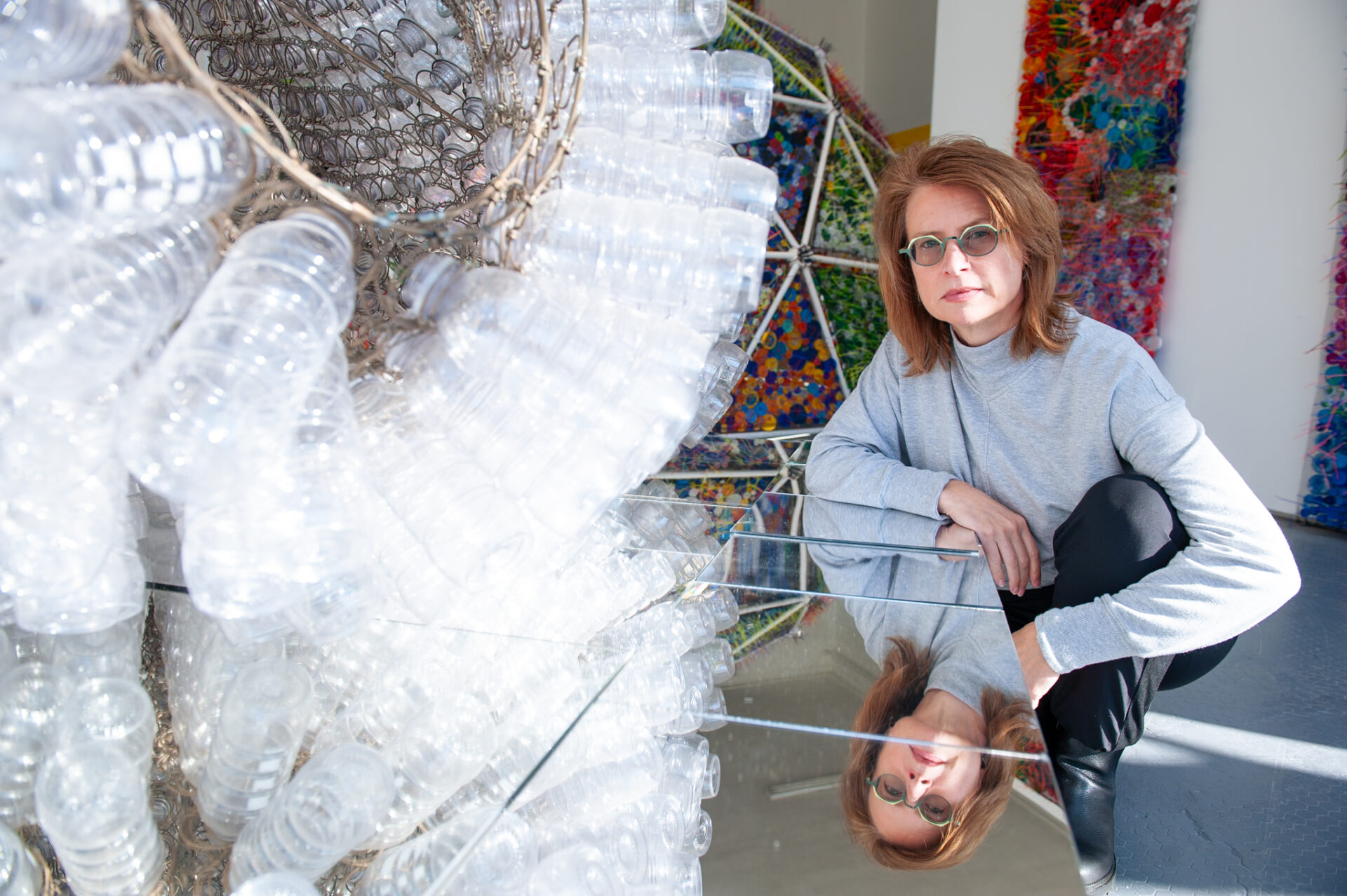 Photo credit: Lindy Drew / HOSTL
“I grew up in the South in a very Protestant, upper-middle-class, white population that told me I should be a nurse or a teacher. But I was not going down that path. I was gonna choose whatever I wanted to choose and get out of there. I remember first getting to Chicago and being shocked to meet Catholics, agnostics, and all these fascinating people. I wondered, ‘Where have they been my whole life?’ It took me until college to meet this whole wide world of awesomeness that I’d never been introduced to from my sheltered existence. And moving to a big city cracked open my worldview.
For my college entrance essay, I wrote about how successful I was going to be in five years as a fashion designer. I look back on that now, like, ‘How cute.’ I actually thought I’d become a fashion designer and a writer. I even became a reporter for television and NPR and wrote several art columns. Well, I didn’t get into fashion design school, probably because of my drawing skills, or maybe they thought I dressed too boringly. Have you seen reels when students at places like Buffalo State University or the Fashion Institute of Technology make videos of what they’re wearing? Like, ‘Come get dressed with me for school!’ They’re just adorable.
It wasn’t until I took a class in the fiber department that everything converged. Because the fiber movement — which is associated with crafts because it’s associated with women — helped me understand how women have had a voice for themselves throughout history. Coming from the South, I’d been taught that you can’t be too thin, too rich, too tan, too feminine. I rejected all of that, so it was a real eye-opener when it came to how I could express myself through art. Especially in a way that was subversive, rebellious, and around intellectual problems, while allowing me to create something of a certain size using a certain material and still make it structurally stable. I loved thinking about these things. And I loved working with organic materials.
Since then, I’ve worked with organic materials ranging from hair to fingernails to a variety of skins. The natural fiber world is very monochromatic. Colors like creams, tans, and ivories are popular. Occasionally, there’s a sage green or rust if you dye it with turmeric. When I switched to working with plastic, I hated it so much. With plastic, the colors are so garish. The material isn’t pliable. Think about how the plastic from produce containers is super brittle. I didn’t even like the sound of it. Plus, it’s all killing the Earth. But this has all been a really profound shift for me because I finally found what will be my life’s end work.”
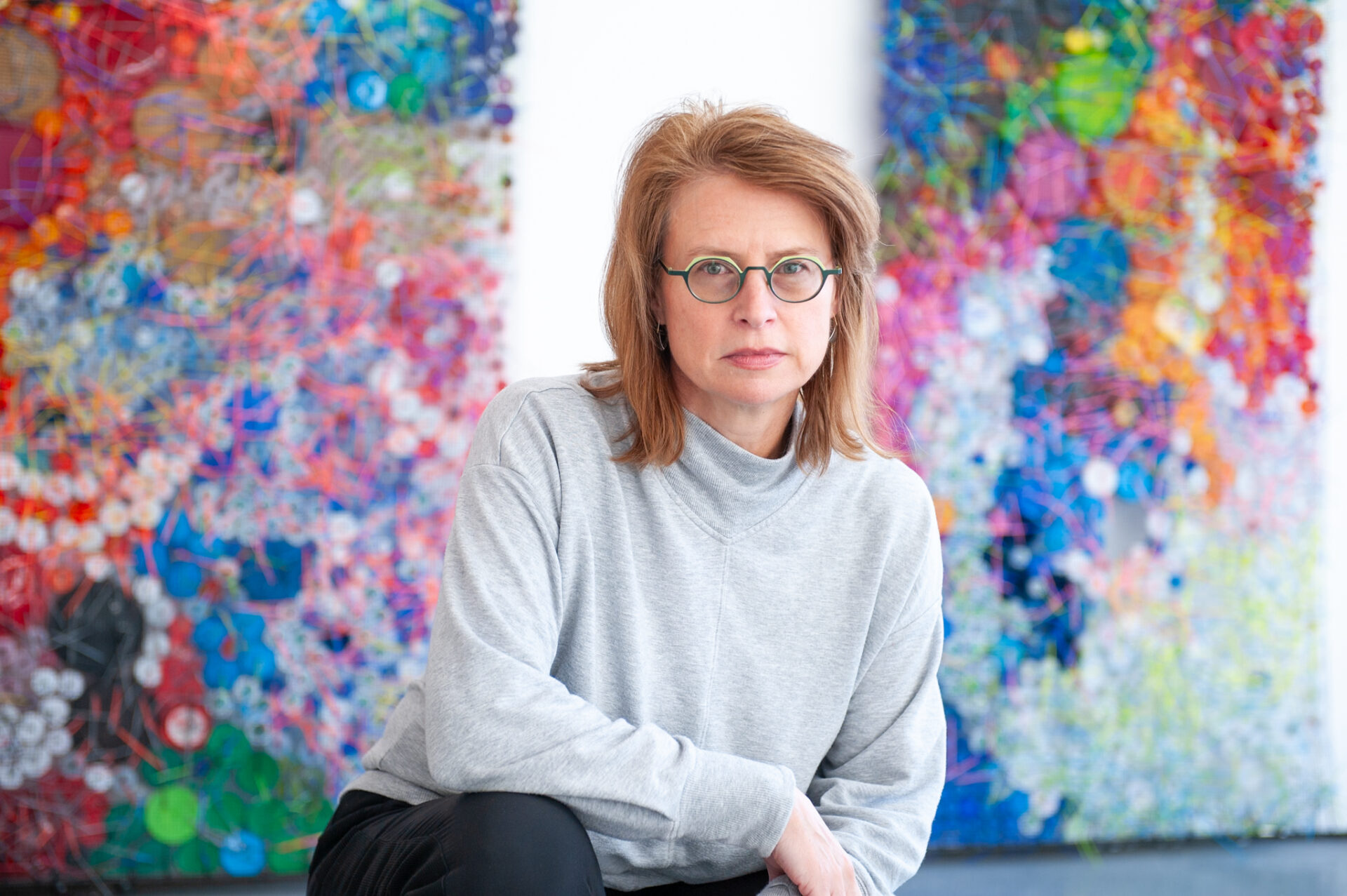 Photo credit: Lindy Drew / HOSTL
“In Nashville, because I was somewhat of a figure in public radio and ran an art center, the public trusted me. When I moved to St. Louis, I made a lot of stumbles. So I retreated here, like, ‘I do not know this city well enough. I’m trying to work with and get to know the activist community, and they do not trust me. Whatever I’ve done, I’m not doing it well here.’ I went to a community meeting that was billed as like, St. Louis Art Culture: Past, Present, and Future, and this is to my total discredit, but I walked in late to the talk and became confused and bothered by why so many artists felt so downtrodden. People were saying they were sad because they weren’t more supported. They felt like St. Louis was not offering them enough. So I was like, ‘I’ve just got to speak. St. Louis is so wealthy. And there are grants out the wazoo here. The arts are actually supported in this city, whereas they weren’t compared to where I just came from. I had to pull teeth to get funding in Nashville. I had to work with an enormous number of partner organizations to get anything off the ground. And here, even though I understand access can be limited, it seems like there’s money all over the place.’ I was finally told to ‘shut up, white woman.’ And that’s when I figured I needed to learn more about the history of this city. That was the moment I realized, ‘Yeah, I’m not the person to partner with because I clearly don’t know enough.’ So I backed up. Then, George Floyd happened. And for the first time, I was researching issues like redlining and how minorities have been suppressed in this country for so long. I’d run around like, ‘Did you know this? I never knew this. And if you knew it, why didn’t you do something about it?’ As much as I wanted to help people, the way I was going about it in St. Louis was not okay. Like, they were gonna kill the messenger before they heard the message. So I needed to find a new way to work with people.”
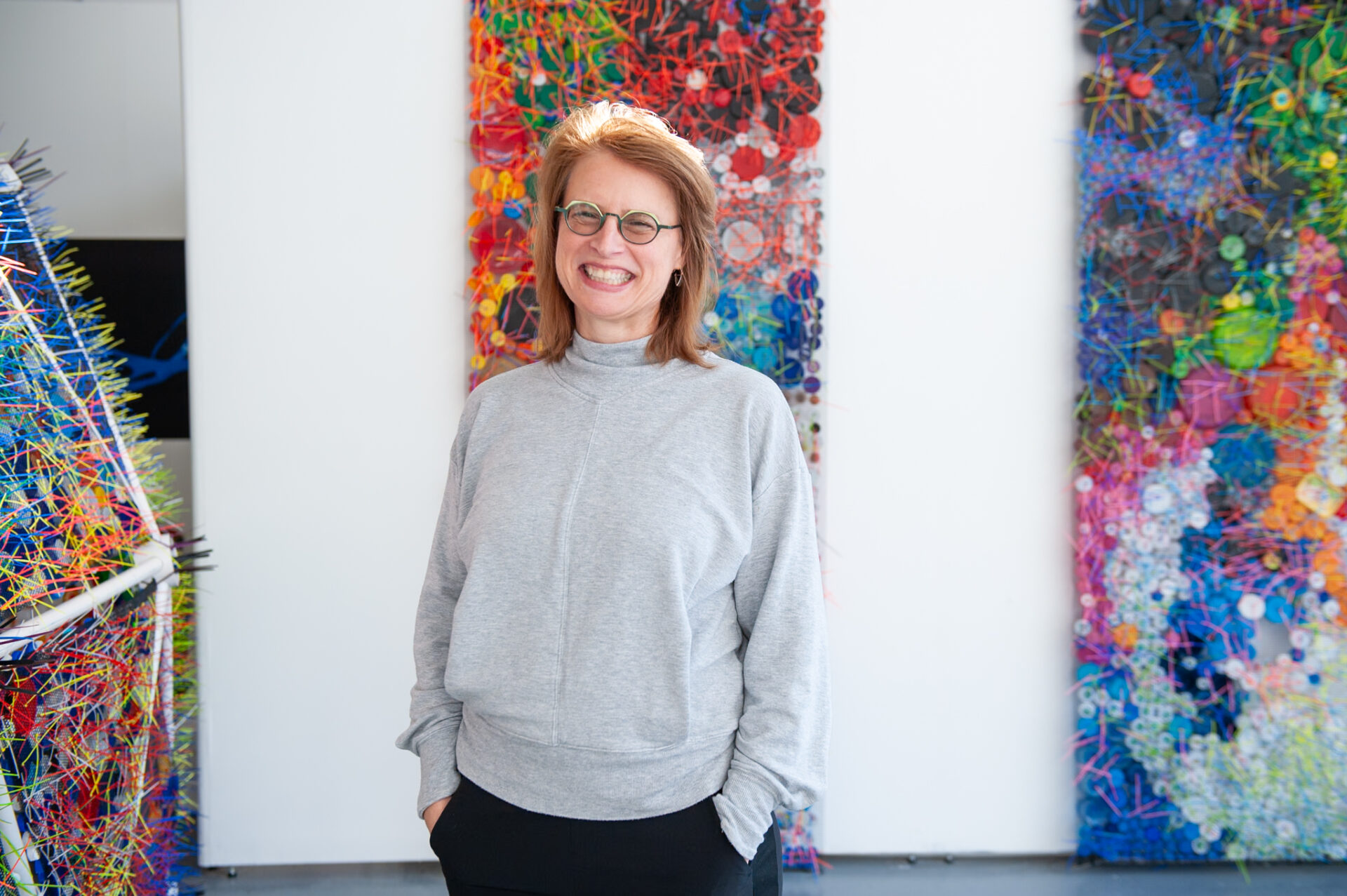 Photo credit: Lindy Drew / HOSTL
“I began thinking, ‘How can I come to the table to do something that will hopefully help our city and the broader population? As a southern white woman who’s got limited knowledge of how people have grown up here, can I make a dent? How can I involve people in the arts or activism who aren’t normally involved? And how can I make it fun for them?’ I remember telling one of my high school interns, ‘We’re gonna do this project, and it’s gonna be disgusting and hot and kind of grueling, but it’s gonna be okay. Let’s just do it.’ He finally turned to me one day and said, ‘You know, if you’d just tell me it’s gonna be fun, it would be a lot better.’ I learned so much from that advice, too. Like, ‘You’re right. I’ve gotta learn how to frame things.’”
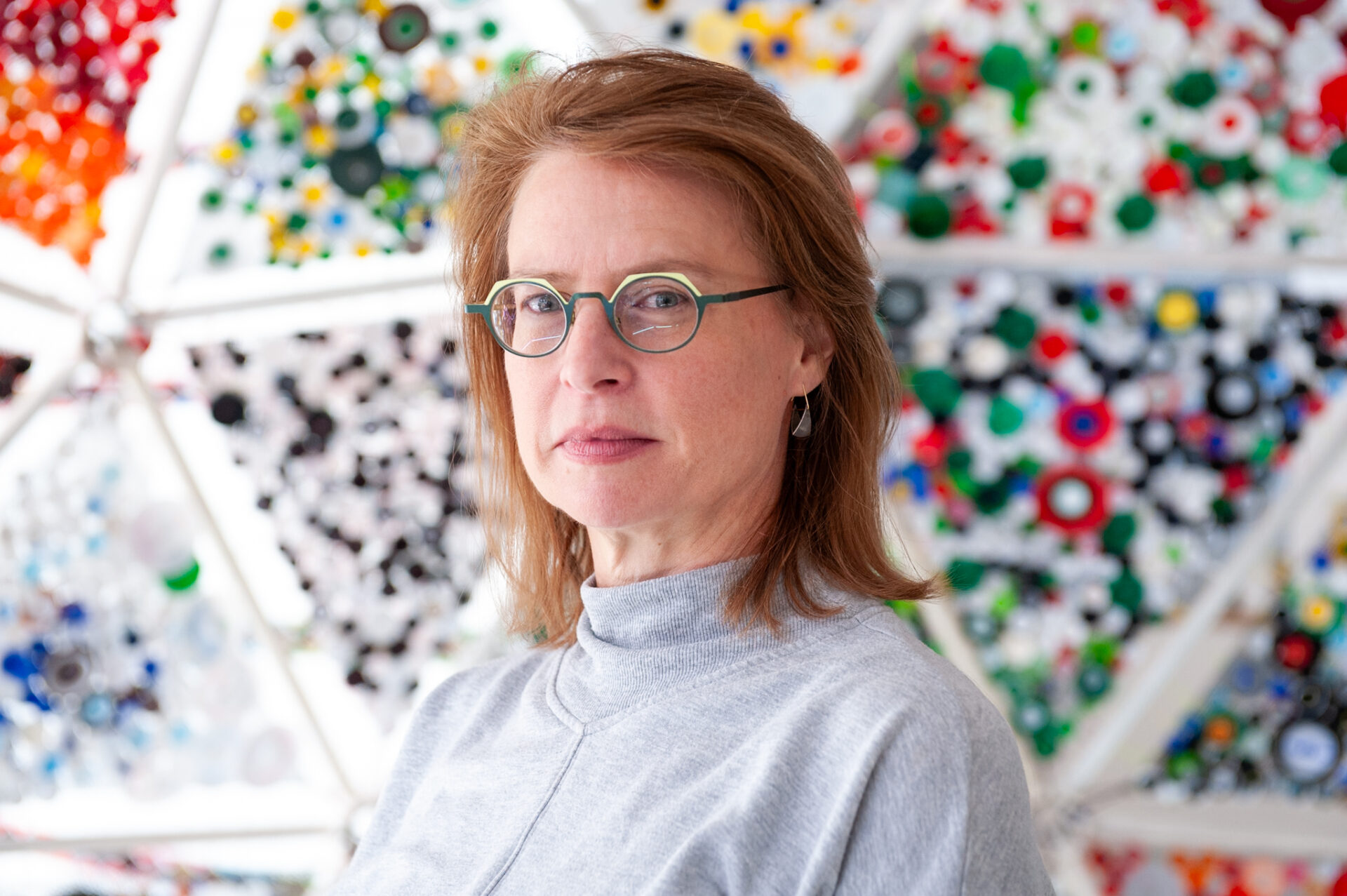 Photo credit: Lindy Drew / HOSTL
“A couple of years after we moved to St. Louis, my husband got a residency in Singapore. So we took the whole family for the summer, and I ended up working with a bunch of social practice artists there. One of the awesome opportunities I got was the chance to experience the Ayer Ayer Project, by Ernest Goh, who made this gorgeous community dinner table out of wood chips. The organic mulch was shades of brown and dotted with all these colorful dots, which kind of looks nice until you realize what they are. Ernest Goh does things so elegantly. And I don’t mean just in terms of the aesthetics of it, but the concept. So we were invited to the table, given these beautiful chopsticks and little paper plates, and asked to pick microplastics out of the woodchips. I’d never seen or understood a microplastic before then. It was like going back to your childhood and doing something interesting with your hands, like when you go to the Science Center and get to dig for bones. We came expecting to do something interesting, and we were flooded with knowledge.
So there I was, pulling out those microplastics, communing with people, getting to know them, and hearing their stories about going to the beach and what microplastics are doing to their communities. It was like being at an actual dinner party, having deeper conversations. I kept thinking, ‘I can help better this world by working on climate issues if I specifically focus on plastic.’ Also, plastic, as a discarded material, is free, and art supplies are expensive. So I knew this new direction would work well on so many levels.”
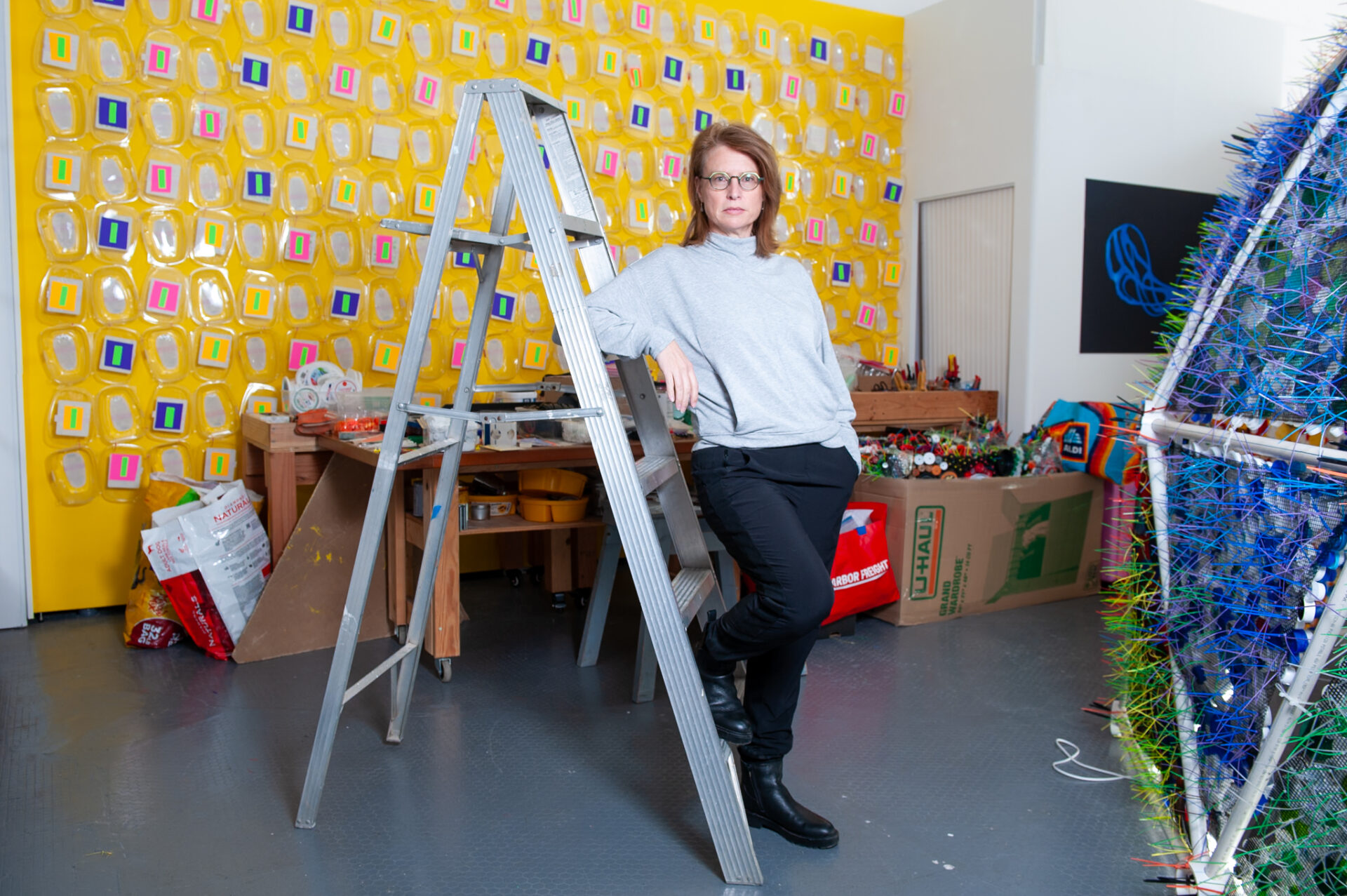 Photo credit: Lindy Drew / HOSTL
“I’ve learned this through several large-scale projects I’ve done where I’d purposefully have people work with their hands to the degree that it kind of took away a filter because you have to concentrate so hard on making the thing I’m asking you to make. For one project, I went into religious organizations, cancer centers, schools, and medical centers. And I’d invite whoever — cashiers to trauma surgeons — and ask them to sew together strips of brass mesh. The project was called Vessels of Grace. And as we made prayer boxes and baskets out of them, participants were invited to write their thoughts and prayers and put them inside. I’d tell them, ‘While you’re working, I want you to think about who has helped you and who has helped you and why.’ And the stories that poured out of them, like, I didn’t realize it would unleash this stranger-to-stranger gauntlet. I wasn’t even prepared to hear them. But because of the places I was in — cancer and medical centers — patients and staff would just pour their guts while doing something with their hands while making this art project together.”
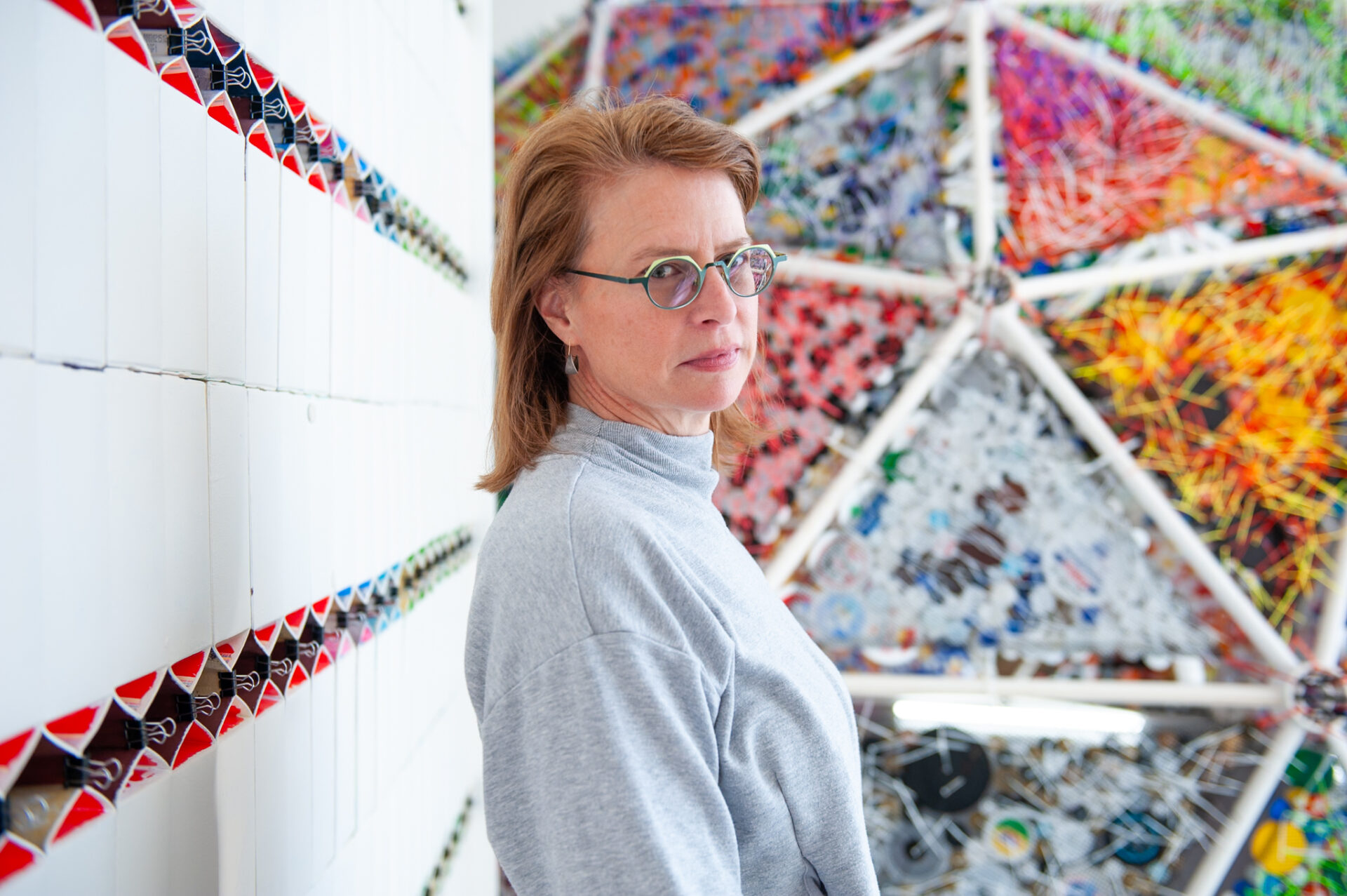 Photo credit: Lindy Drew / HOSTL
“While I was just starting to get interested in working with plastics, articles came out that China refused to accept our trash from the U.S. Again, I was already flabbergasted about all this stuff going on in St. Louis and from our city’s history, and I also had no idea that our country shipped our trash. In Singapore, where we were staying, we had to have a cleaning person come to our apartment. The whole thing was very weird to me, and it was also very upsetting, in part, because I couldn’t speak the person’s language. Well, I was doing an artwork there in which I started saving all of our family’s food containers. And I’d hide them every time she came over because I thought, ‘This person’s gonna think I’m out of my mind.’ And I couldn’t explain to her what I was doing because she spoke Malay. My exhibit was made of cereal boxes and beer cans, and I called it 𝑊ℎ𝑎𝑡 𝑊𝑜𝑢𝑙𝑑 𝑀𝑎𝑟𝑖𝑎 𝑇ℎ𝑖𝑛𝑘? Arranging all that was my first foray into making art focused on environmental awareness. I’ve always been a sucker for environmental issues. I’ve just never understood why people want to do destructive things to our Earth. Well, once you start amassing all of these products or their packaging, it makes such a visceral impact. Every week, I wondered, ‘What is Maria gonna think? How am I gonna squirrel all this away?’”
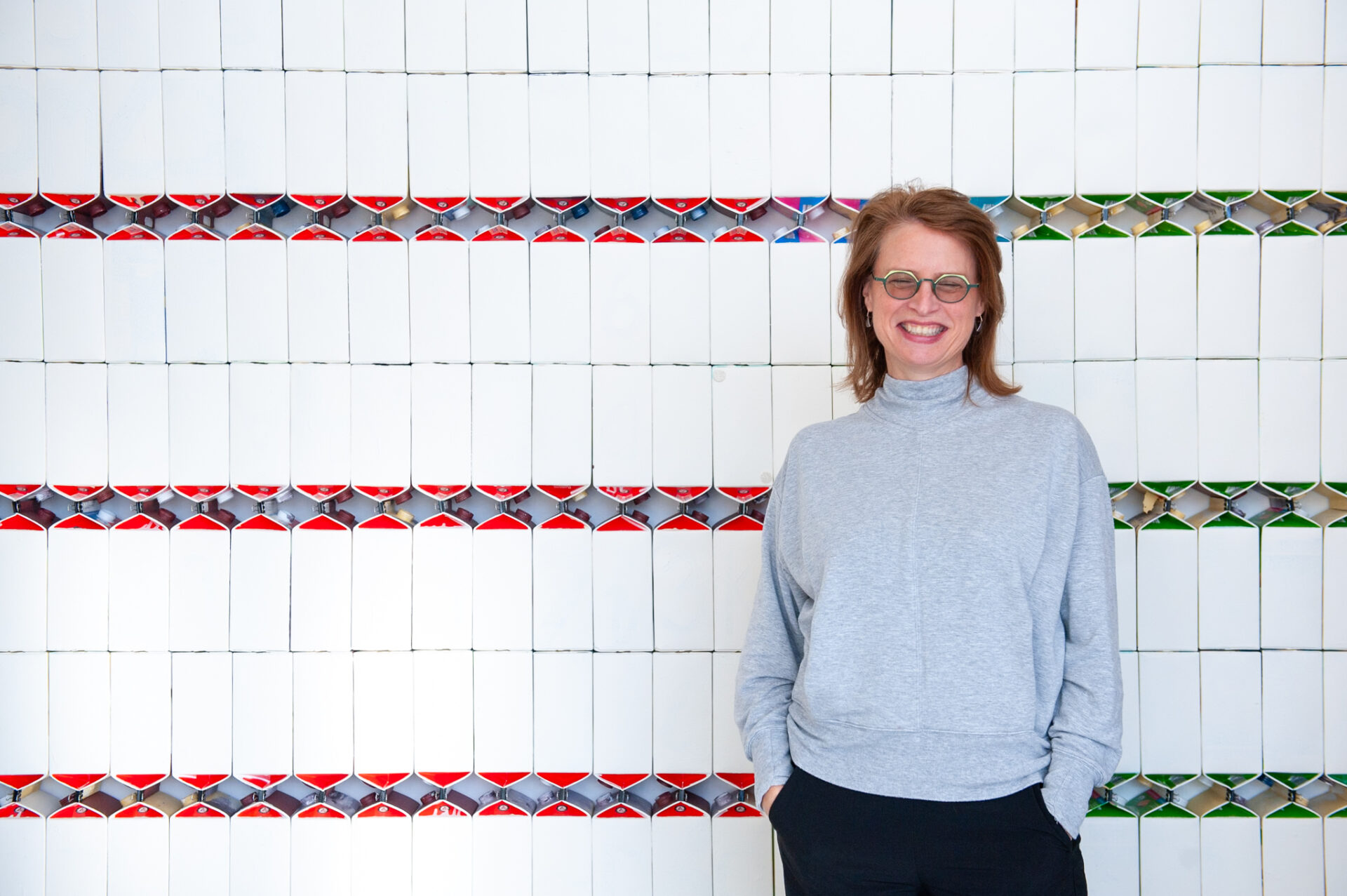 Photo credit: Lindy Drew / HOSTL
“Returning to the U.S., we’d been in St. Louis for a while when COVID hit, and I just kind of became a bag lady for a bit. Every day, I’d bring bags of our trash to the studio where I cleaned and categorized it. I wasn’t depressed. I was producing interestingly and functionally. But I didn’t really know where I was with my artistic practice. I made so much furniture, although they weren’t art pieces. I just desperately needed to keep myself busy. So I built 11 planters out of cedar. I put together built-in bookcases. I hacked an IKEA toy chest and turned it into a bench/dog crate. I was very proud of myself. And I knew I just needed to be creative. Like, when I’m not making art, I end up being much more creative in my home life. I start dressing interestingly, or I have weird hairstyles. So, when I say I was a bag lady, I knew I wanted to do something with some new materials, but I couldn’t think outside of a paper bag at that time.
My husband was going into work every day, whereas I was freaking out about dying and forcing my child to stay home from school. And to keep busy, I was also collecting and cleaning my family’s trash. Because, again, to make a visual impact, I figured, ‘Whatever I do, I’m going to do something showing what we accumulated.’ When I did that in Singapore, it was fascinating for me to see what waste we created in the time we lived there, like what we regularly ate and what the packaging looked like. I wanted to do that here, not even understanding what I was about to do for forever until the light bulb went off.
Luckily, my husband’s an extremely consistent eater. So I started cleaning containers and categorizing them. But this was also hard for me because I came from a background where my work was extremely participatory. Like, I needed other humans to add to my installations to finish the work. At the same time, during COVID, I realized, ‘The world’s changed. If I can’t have people all up in each other’s business anymore, how is this gonna work?’ So I cleaned and painted all our milk cartons, painted one side of them all white, and displayed them in my studio like subway tiles.”
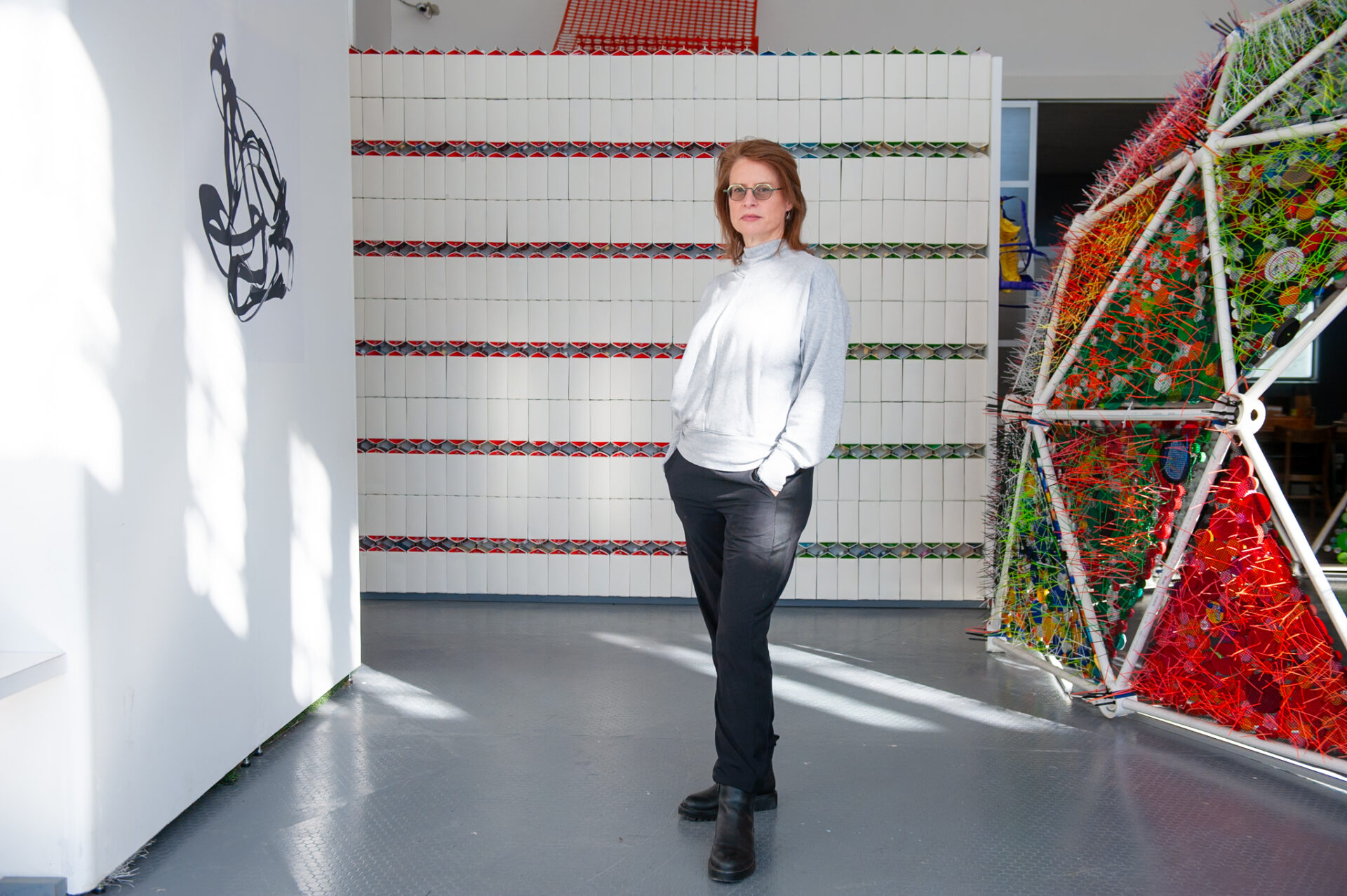 Photo credit: Lindy Drew / HOSTL
“What I love about reusing materials is that I have limitations of working with what I have. I can’t just make whatever I want and go buy paint or whatever. So this wall is 8 feet tall by 14 feet wide, and it’s the exact number of milk cartons we drank as a family over 18 months. When I was laying them out on the floor and decided to color-coat them, I realized it looked like a rainbow. And the reason it looks like a rainbow is that the first quarter of cartons is my portion from the family, and I’m lactose intolerant. So the boxes are for almond milk, soy milk, oat milk, and then regular milk. People often don’t realize what the message is until they’ve walked around to take in the whole thing. But the point of this first iteration of the show was to show my family’s trash. And I’m not here to judge you about what you do with your trash, because we’re talking about my family’s trash. But I appreciate when people come to the gallery and recognize, ‘I drink that same milk. Or, look at all the things we consume.’ It’s a lot. It’s a whole lot. I haven’t even finished using all of our trash I collected during that period of time. There is so much.”
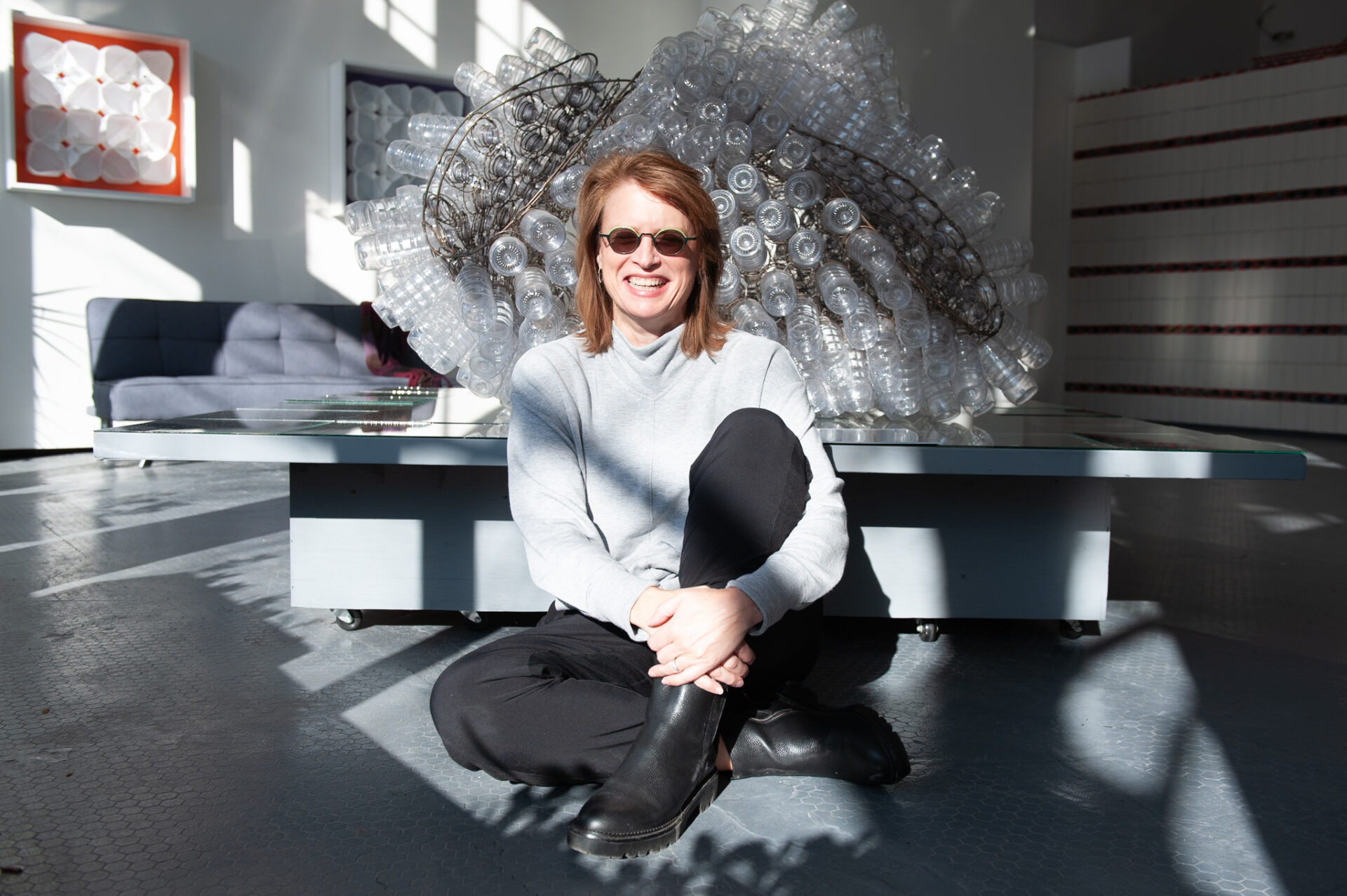 Photo credit: Lindy Drew / HOSTL
“I also displayed a small portion of Vitaminwater, which my husband used to drink. I had an old mattress spring I used in another exhibit, so I dug it out of the trash and cleaned it up. Looking at it, I wondered if one of the bottles would fit inside one of the springs. So I stuck it in there, and it fit perfectly. Playing with it, it became this gorgeous fortune cookie, or vaginal or flower opening. My husband saw the immensity of material from what he had consumed and immediately switched to a powder form. And that’s the kind of behavior change that could happen from seeing this piece. People come into the studio, look around, and are realizing what packaging they leave behind as consumers, too.”
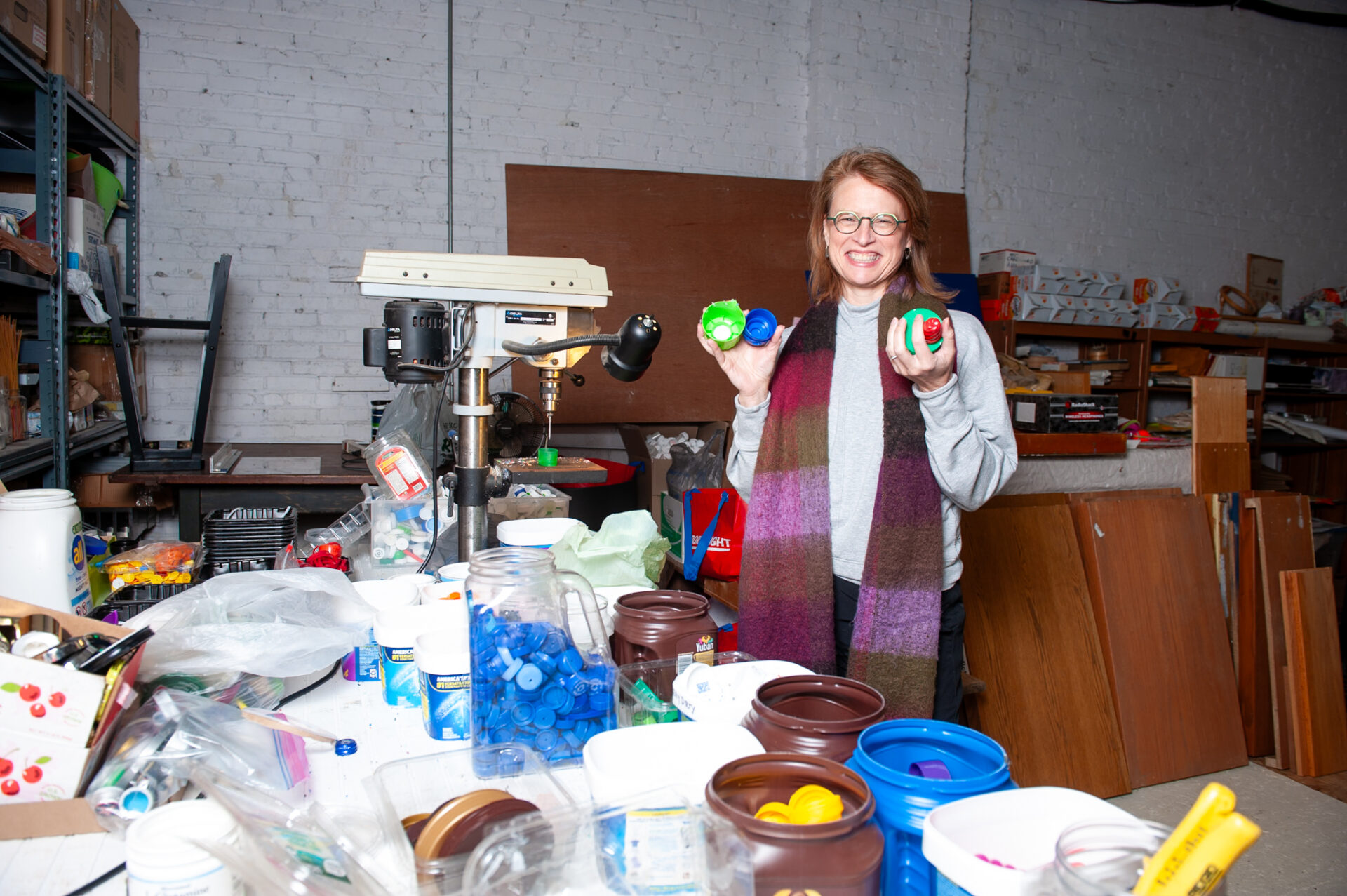 Photo credit: Lindy Drew / HOSTL
“Eventually, I had two sides of my art that were coming to life: super minimal and super maximal. I was making this very minimalist work that resembled subway tiles on the wall, and I made this clear plastic sculpture of the bottles. And all that was happening while Mr. Beast was using his platform to promote #TeamSeas, people going out to the Great Pacific Garbage Patch, and picking up a bunch of garbage to call our attention to just how much of it is in the ocean. It is mind-boggling how much plastic is out there and what they collected. Well, my daughter, who follows Mr. Beast, said to my husband and me, ‘Y’all are handing me a world on fire. I don’t know how I’m supposed to trust any of you. You’re such hypocrites.’ And in that moment, she called out the hypocrisy as our world is shifting so much.
I thought, ‘I’ve got to do something to show this generation that most of us try to make the best decisions. And in real time, it’s hard. Corporations knew what they were doing when they introduced so much plastic waste. But how many of us consumers understood it was never gonna biodegrade? So I got an idea to make a sculpture with my daughter and her middle school. I said, ‘You’re gonna design it, I’ll fluff it up, and we’ll see how this goes.’ So we made an adorable little orange fish in an ocean. And I fastened bottle caps with brass fasteners to this mesh panel that the school gave us to use. And on the back side of the sculpture, the brass fasteners show the movement of ocean currents.
I had said to the school, ‘Let’s get the whole campus involved. We’ll do a community cap collection, where everyone can bring in plastic bottle caps.’ So people started bringing this stuff in. And what was fascinating was wondering and then recognizing where these caps came from. Like, ‘What are these weird two-inch tall plastic caps with swirls on them? Oh, somebody really likes Dairy Whip.’ And I’d see the enormous amount of Coke products coming in. Well, after the piece was done, people kept contacting me, asking, ‘Do you want more caps? I have caps.’”
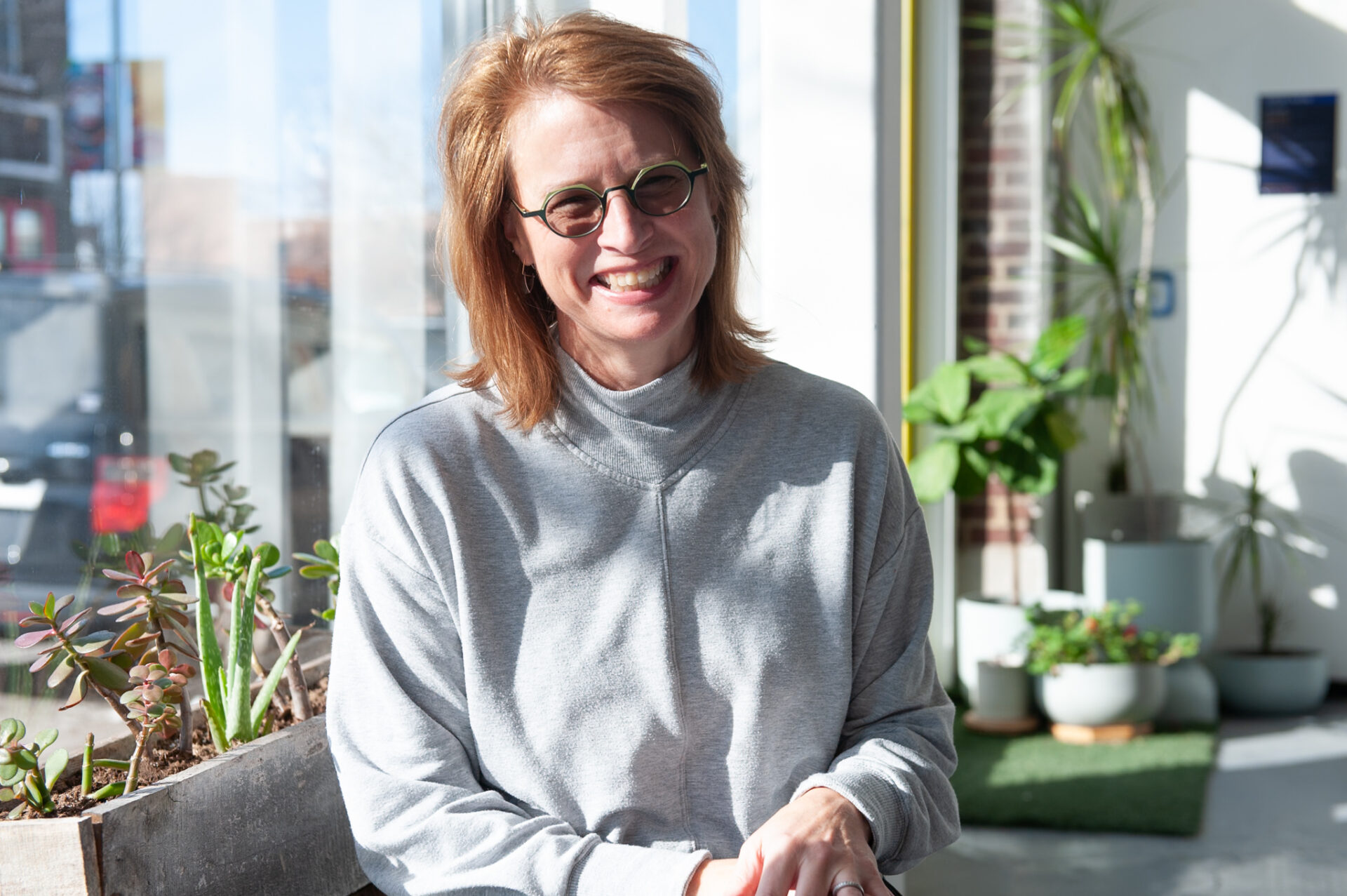 Photo credit: Lindy Drew / HOSTL
“I think it’s critical for everybody to be able to take a step back and make more informed choices as they go along. I was very privileged to be able to do that when I moved here. At 55, one of the nicest things has been having time to reflect on and understand why I’ve made the choices I’ve made. It was really hard and isolating, but awesome. As part of researching the history of St. Louis, I was paying attention to where we’re located, too. And I discovered that the Mississippi River is a watershed for 40% of the United States. So plastic from someone in, say, Denver, Colorado, ends up in the South Platte, which ends up joining the North Platte, which ends up joining the Platte River. Then it goes into the Missouri River, which flows into the Mississippi. St. Louis is a critical juncture for stopping what I call the plastic pollution pipeline, where things flow down the Mississippi into the Gulf of Mexico and then out to the ocean, where people with groups like TeamSeas have to pick it up. And it made me think about how if we can clean up our bodies and streets, we’re cleaning up our water and our world.”
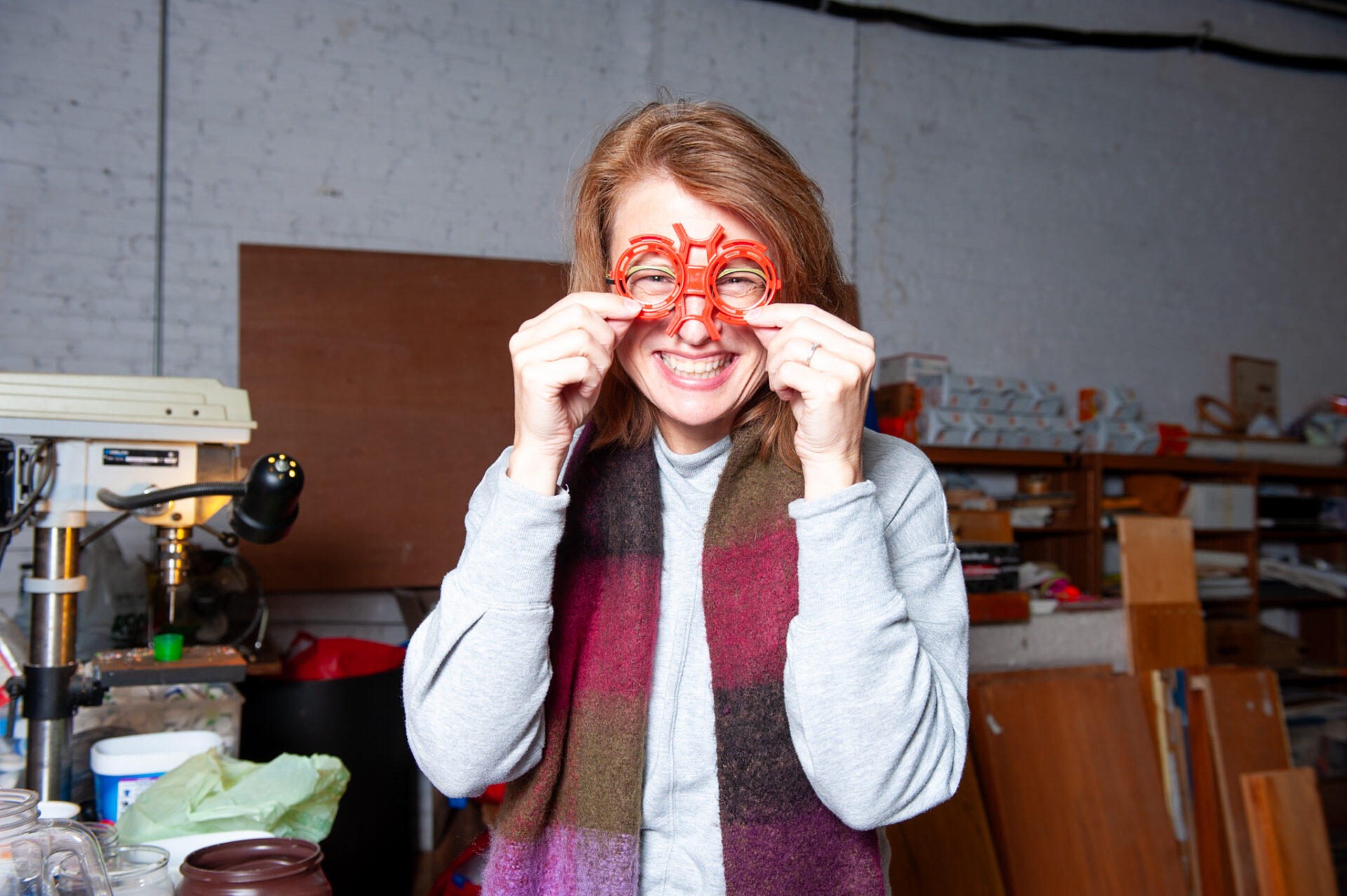 Photo credit: Lindy Drew / HOSTL
“My work is intergenerational on purpose. Everyone who participates has a voice in it. It’s not just mine; it is all of ours. For my daughter, our art project helped quell her climate anxiety a lot. Especially to know that she expressed her concern and someone listened and did something. I think if an idea comes from a woman, child, or old person, a large part of what’s problematic is that no one listens to them. And if we all come together, it is a force of nature. My daughter was just telling me she was talking about her parents to one of her teachers, and her teacher said, ‘Wow, you speak very highly of your parents. Very unusual.’ How beautiful for her to speak highly of us. I’m happy about that.”
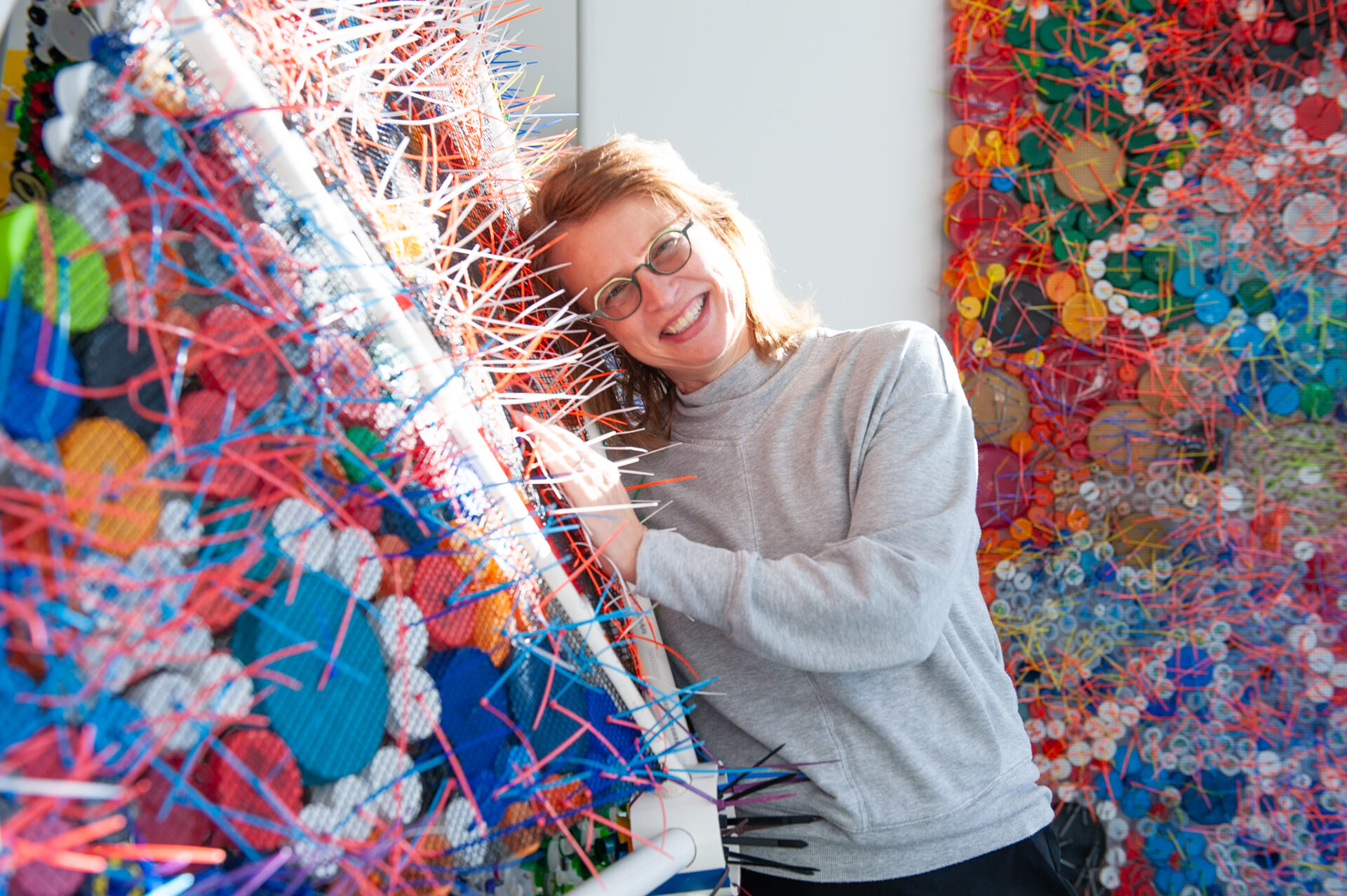 Photo credit: Lindy Drew / HOSTL
“So I worked with a whole bunch of people who helped me lay out and design two big pieces that came out to be eight feet tall by three feet wide. And it took me three years to finish it because I kept fussing with it. That’s another story. But the piece is hanging in my studio. Well, I went across the street to work with Big Muddy Adventures, which has an arm where they take underserved populations out into nature. And Chris Gedden, who’s in charge of the youth program, said, ‘What our kids need to do is work for you.’ So they’d come to my studio, and I’d have them make work out of my trash. I remember I had these panels hanging in the studio, and they were attracted to them like flies to honey. The colors, the texture, and the pattern made them all flock to this piece, standing there for like 10 minutes talking about the artwork, and the details, recognizing what they had consumed, and it was just phenomenal. I was like, ‘Oh my god, I’m doing what I wanted to do.’
Ever since then, people still bring me caps, and I’m now friends with so many of them. For example, my air conditioning went out this summer when I had this huge project, and I posted about it because I was frustrated. So one of my cap collectors, who I didn’t know at the time, was like, ‘I have a fan. I’m gonna bring it to you.’ Then another woman got in touch with me, saying, ‘I have a bunch of caps I’ve been collecting for a long time. I just haven’t figured out what to do with them. Can I bring them to you?’ I was like, ‘Sure.’ She not only brought them to me, but she cleaned and categorized them by color. Of course, she came from a science background. I keep trying to be friends with her. She actually wrote me a couple of weeks later, too, like, ‘Listen. I work with Forest ReLeaf and the Missouri Botanical Garden. Can I reach out to have them collect caps? You don’t even have to pick them up. I’m gonna pick them up for you.’ Did I mind? Please. That was awesome!”
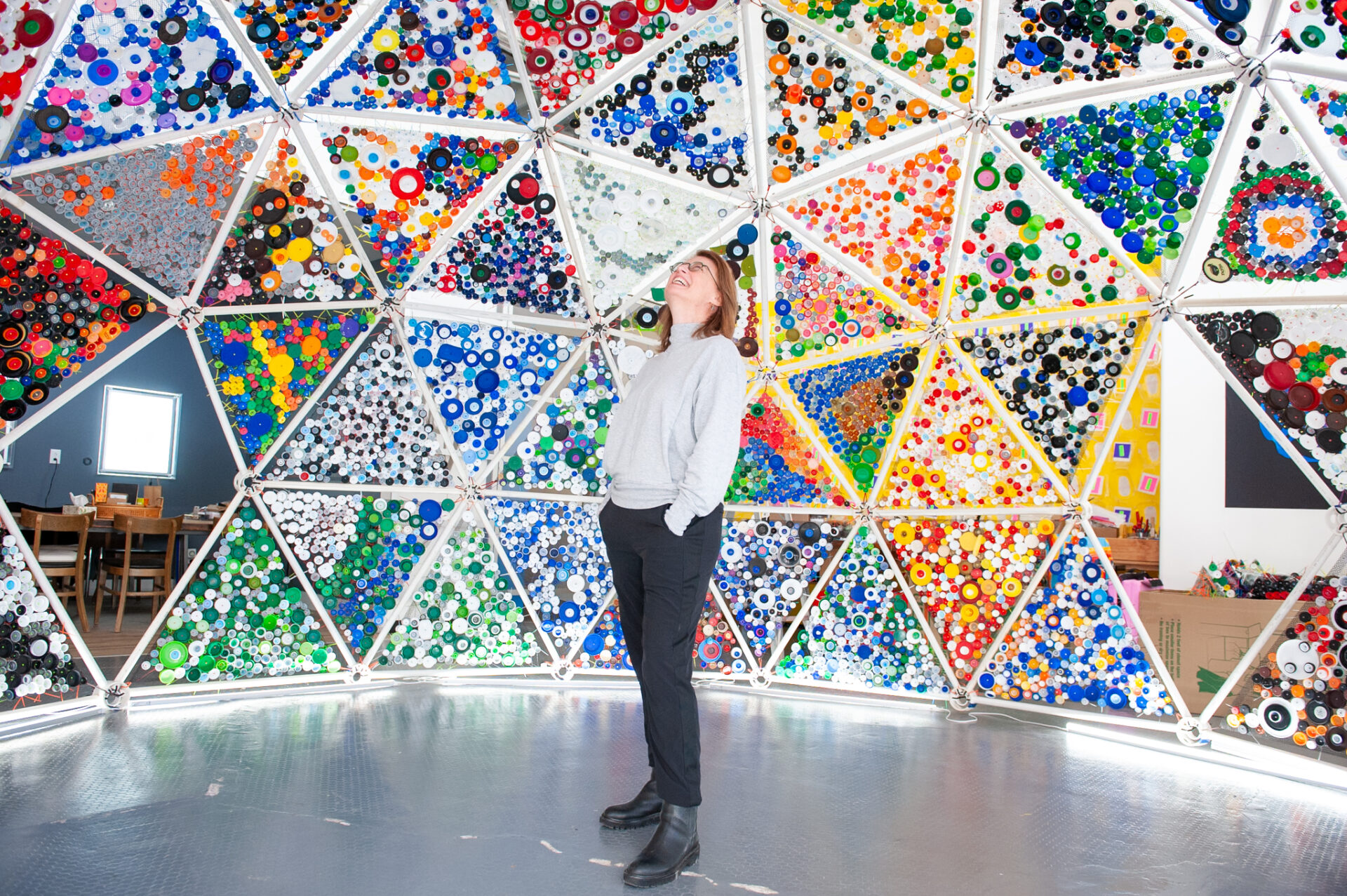 Photo credit: Lindy Drew / HOSTL
“People want a solution to the plastic pollution crisis. We don’t have good ways to recycle. And that is, in part, because the technology is constantly changing. The way we have to adapt our behavior to actually have those items be recycled is also changing. In the past, we were supposed to put caps in one place and bottles in another. Now the caps are supposed to be on the bottles. Well, does that information get communicated to the public? People get frustrated because they’re diligently trying to recycle their materials, but they’re not sure if what they recycle is even going to the right place.
What we need to be doing is putting more pressure on corporations to come up with solutions because they’re the ones producing all of this. At the same time, the reason I start all my art projects by having people collect their own caps in their own homes and in their own privacy without having to expose their soft underbelly to the world is, first, because they’re consuming, and second, they can start the habit of recycling. What is it, 21 days to form a habit? And, third, they’re seeing their discarded materials go into a beautiful artwork. I mean, these are so pretty when they’re together, because the colors are gorgeous. In addition, they realize that while they may have only given me three caps, their sibling has also given me three caps. And their neighbor has given me three caps. And that person’s neighbor has given me three caps. Then you see it all together.
The most recent work I made was two geodesic domes completely encrusted in bottle caps. They’re part of a series of large-scale public installations shown across museums and civic sites. And altogether, from a distance, it looks like stained glass. That’s one way I show it. The other way, it looks like an earth mound. It looks like fecundity. It looks like the power we have when we all come together. Remember that Al Gore documentary 𝐴𝑛 𝐼𝑛𝑐𝑜𝑛𝑣𝑒𝑛𝑖𝑒𝑛𝑡 𝑇𝑟𝑢𝑡ℎ when he said, ‘If everyone switched out a light…’ and everybody made fun of it? But it was completely true. Again, the messenger killed the message. So I’m trying to make this work positive and fun. I’m trying to make it joyful and vibrant. Because I want to attract you to it. Like, ‘What is that large, colorful thing I’m seeing? I don’t understand what it is, but it’s kinda awesome.’ And you can go inside it.”
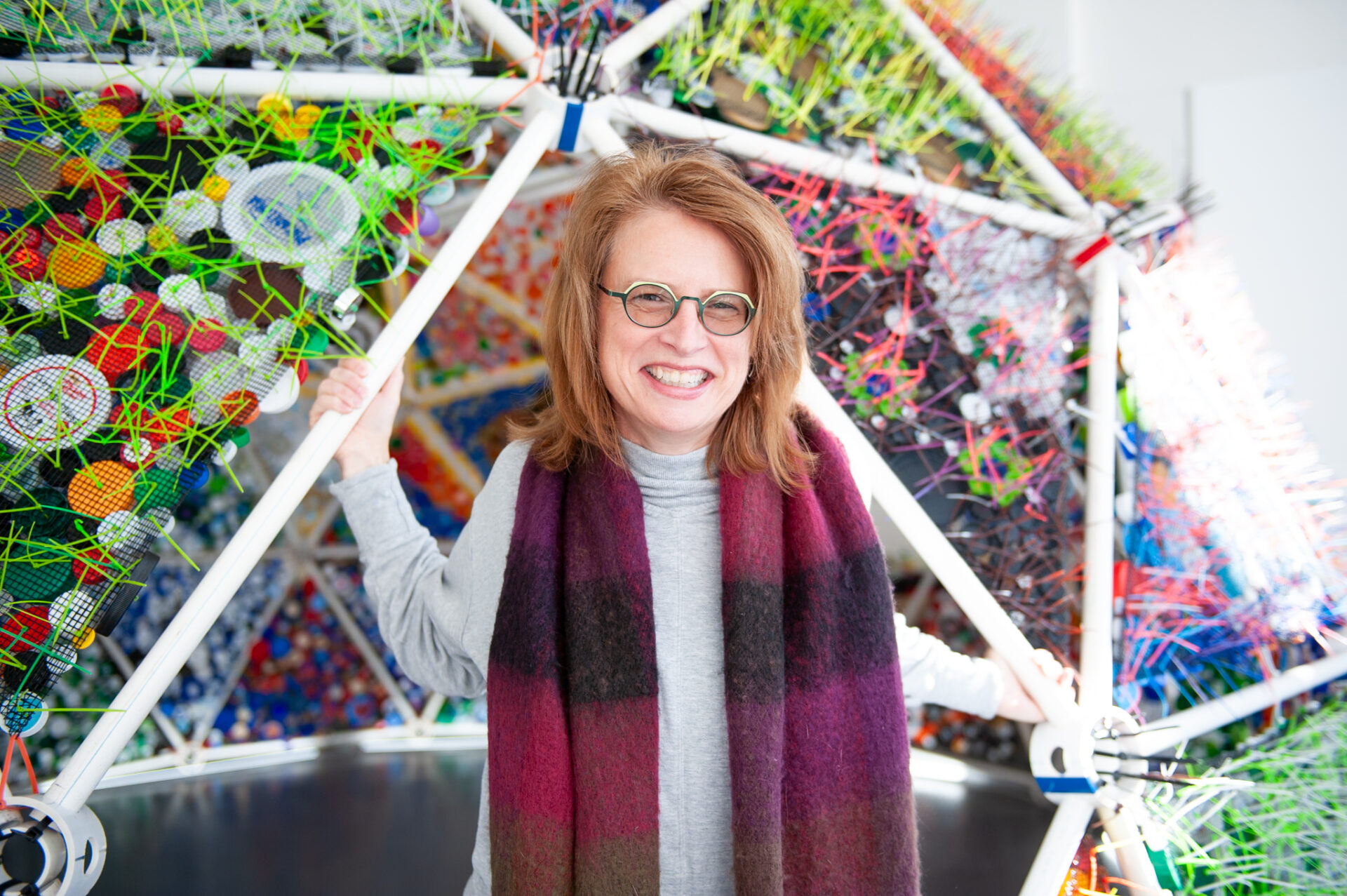 Photo credit: Lindy Drew / HOSTL
“I’d been interested in working in a modular format, so I made this 1,000-pound artwork, which was super hard to do because I was pregnant, and I called it Shelter. I invited 300 people into my studio over a year, and they helped me construct a 7-foot-tall, 5-foot-long, 3-foot-wide shelter that looked like a Gothic arch or a rib cage. And every time people came in to help build this, I’d ask them, ‘Who has shelter, who doesn’t, and why?’ Then I’d ask them to share what their idea of a shelter was.
I’m kind of obsessed with shelters, be those psychological shelters, physical shelters of clothing, or shelters that help keep you alive. And with the devastating climatic episodes that are happening and people losing their shelter, I’ve been thinking about what a viable nomadic shelter could be that’s erected quickly and efficiently. And, you know, Buckminster Fuller was sort of the super-marketer of geodesic domes. He wasn’t the one who invented it, although people think he was. But he happens to be from St. Louis. And there are the earth mounds in and near St. Louis. So I wanted to comment on all of that and make something nomadic. It took me six months of hardcore research, but I found this guy who lives an hour outside of Nashville who invented Zip Tie Domes. So you can make the whole dome out of PVC pipe and zip ties. I told him, ‘We are super buddies.’ Turns out, we are. And the beauty of this, in addition to the fact that it’s very lightweight, is that one person can build them. One person can move it. You can cut the zip ties, take the whole thing down, and move it somewhere else.
Even cooler, while looking for PVC piping, I went to Facebook Marketplace, and lo and behold, some farmers in Illinois had the exact quantity I needed that they needed to get rid of. So I met them in the middle of a cornfield, and we just had a conversation about the domes, climate change, and how the farms were doing. The whole thing was awesome. And, specifically for St. Louis, again, I wanted to reference the fecundity of the earth. What if it’s allowed to thrive? Or if we could quit messing with it? Or if we clean it up? Also, most of the people involved in my projects are women, which I find fascinating because we’ve always sort of been caregivers of the world. So the pregnant belly comes to mind.
The dome is my first foray into a much more immersive experience, and with the element of surprise. So when I did the project in Michigan and Tennessee, the caps were outward-facing. When people looked at the structure from a distance, they thought it was like stained glass. Then they’d enter the dome where the zip ties faced inward, so it was much more of a sensory experience. I also hired someone to do storytelling about the environment. And I hired a yogini to do yoga practice and meditation in there. It was just beautiful. It was, ‘I’m getting to know you, and you are getting to know me, and we’re in this giant festival, but we’re enclosed in the semi-privacy of this dome.’”
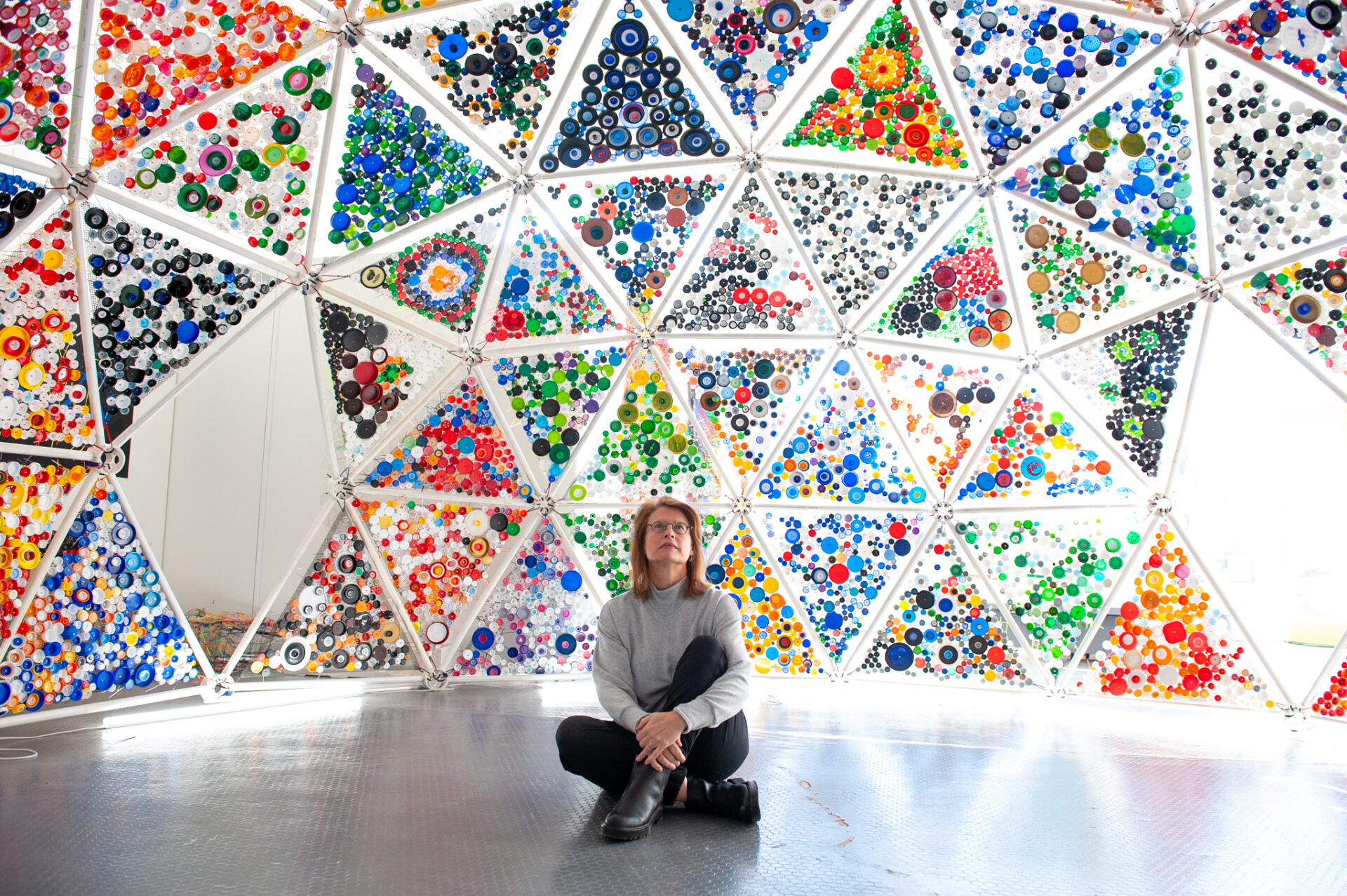 Photo credit: Lindy Drew / HOSTL
“My work is human-centered. It’s not just about the formality of what the work looks like; it’s also about who has helped to have a hand in it. My husband’s a scientist. When he writes papers, his name appears last as the principal investigator, which I find fascinating because in the art world, it’s always the artist who’s the star, not all those other people who also may have participated to make someone’s art. So I’ve learned to credit everyone who helps make my work. And when I exhibit, I include that information. Probably 1,000 people helped me make this geodesic dome. I’m still collecting names, but every single day, someone showed up to help. Normally, you’re working by yourself, even if you’re doing social practice work.
You’re figuring out how to work with people or make something in an isolated environment in your studio. Maybe you’re researching, and you’re in a library or with your computer by yourself. Then you try to find a venue that’s gonna make sense. Then you hope someone’s gonna come to your show and write about it, buy a piece, or whatever. The whole process of making art is sort of filled with anxiety. And with this project, every single day, there were people there. Some guy from Columbia, Missouri, brought me three garbage bags of bottle caps. I had people shipping them to me, to which I was like, ‘Stop doing that. Just hold onto them.’ Like, one woman said she’d been collecting them for a number of years, couldn’t find anything to do with them, and was going to drive an hour and a half to see me at the site. I was like, ‘Hold up. Where are you? If you’re on my route, I can just meet you there.’ So we met in a gas station parking lot and had a wonderful exchange. You know, people rescue me with their fans. And people like you reach out, like, ‘Can we talk about your art?’”
 Photo credit: Lindy Drew / HOSTL
𝑊ℎ𝑎𝑡 𝑎𝑏𝑜𝑢𝑡 𝑦𝑜𝑢 ℎ𝑎𝑠 𝑐ℎ𝑎𝑛𝑔𝑒𝑑 𝑎𝑠 𝑎 𝑐𝑜𝑛𝑠𝑢𝑚𝑒𝑟 𝑎𝑛𝑑 ℎ𝑜𝑤 𝑦𝑜𝑢 𝑠𝑒𝑒 𝑡ℎ𝑒 𝑤𝑜𝑟𝑙𝑑 𝑏𝑒𝑐𝑎𝑢𝑠𝑒 𝑜𝑓 𝑦𝑜𝑢𝑟 𝑎𝑟𝑡 𝑝𝑟𝑎𝑐𝑡𝑖𝑐𝑒?
“I’m much more forgiving of myself and others. If you’re a single mom or dad trying to survive and feed your kids, and you’re microwaving something with plastic, that is what you have to do at that time. You need to have time and mental and emotional space to be able to even get in the habit of changing our consumer behaviors. And I’m always saying to people, ‘Do not stress out about what you’re consuming or what you’re doing with it. Take it one little step at a time.’ What this project has done for me is see the accumulation of going from getting three bottle caps at a time to sometimes getting 300 to sometimes getting 3,000; you realize how many people have come together to make this art. And I think it’s equally as powerful if we can tap into that desire of people to be in community with other people in real life and do something fun together. You know, why do we always have to talk about the climate like we’re all gonna die? That just makes me sad. And from my art practice, I’ve just come to have a much greater love for and respect for humanity. Whatever change I create, I want it to be lasting and impactful.”
Adrienne Outlaw | adrienneoutlaw.com
About Humans of St. Louis
Humans of St. Louis (HOSTL) is a 501(c)(3) non-profit organization with the mission of sharing photographic portraits and first-person stories to highlight local needs, issues, and experiences from people in the St. Louis region. HOSTL gives followers an intimate look into the lives and struggles of the people of St. Louis, one photo and story at a time, and is the second most popular “Humans of” site in the U.S. after Humans of New York.